
The Problem with Red, Yellow, Green Project Status
Many years ago I worked in a Project Management Office at a large financial institution. Once a week I prepared a project status report for executive management and the PMO director. I would calculate how we were tracking to budget, list any major issues or risks, and summarize overall status.

I was also told to mark the project as red, yellow, or green – using the following definitions:
Red: Serious issues and the project will probably be delayed or have significant budget overrun.
Yellow: Potential issues with schedule or budget, but both can probably be saved with corrective actions.
Green: On schedule, on budget, all good.
The red/yellow/green approach seems simple and logical. You only worry stakeholders if something goes wrong, so green projects do not need much review or attention.
Related Article: Starting at Red
However, in my experience the color approach has many shortcomings and potential repercussions. Let’s look at few.
Expectations
What happens when a green project turns yellow or red? In my experience there is an emotional conversation with stakeholders. Here are some of comments I frequently hear when a project goes from green to yellow:
“What went wrong?”, “Why didn’t you manage this project better?, “How can we avoid this happening again?”, “Why didn’t you see this coming?”.
As a project manager I often feel great guilt with these conversations and I too question my competency. But if we spend a moment and work our way through the guilt and emotion, we can see this issue from a more analytical perspective.
Not in line with normal project uncertainty
You may be familiar with the cone of uncertainty. The cone of uncertainty tells us that you cannot completely understand all of the tasks and potential issues within a project, at the beginning of a project.

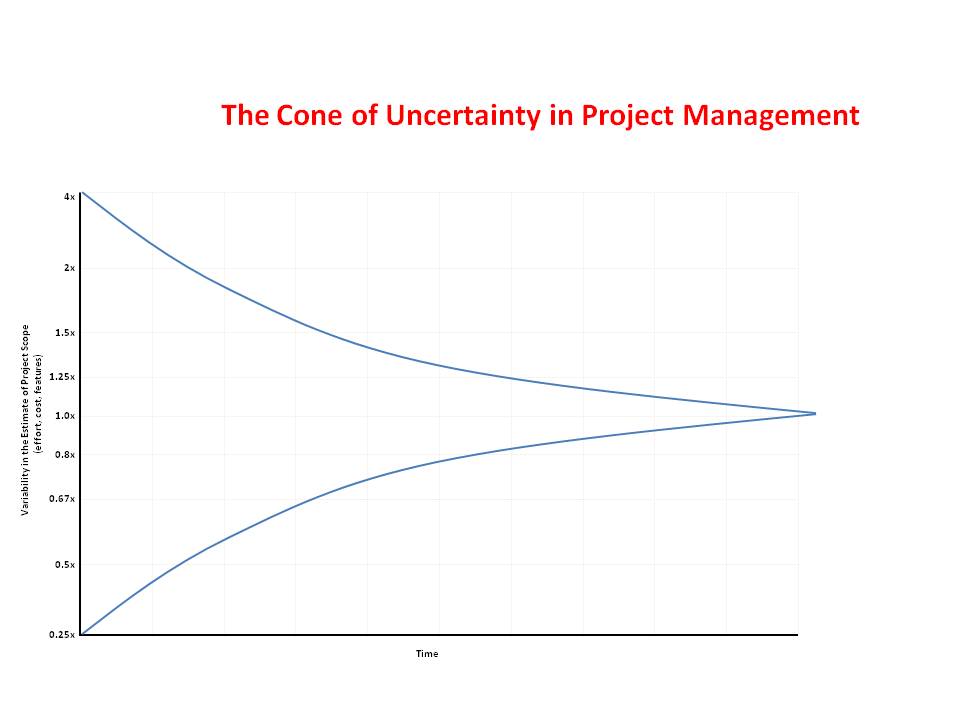
As the project progresses we learn more and there are less risks, but we can never anticipate everything that could go wrong until the project is 100% complete.
When we label a project as green we are telling the sponsor everything is OK, today.
Sponsors interpret green as everything is OK today and it should be for the entire project. It is human nature to assume the project is under control and should stay under control.
A Different Approach
But since any experienced project manager knows that green does not necessarily mean green forever, we need to speak in verbiage that stakeholders can relate to. To address this issue I have changed my color scheme when working with sponsors and removed green from my status options.
My options are now:
Yellow: The project does not have any known issues but there is still high risk that something could go wrong (as demonstrated by the cone of uncertainty). As with any project in flight, we are managing it cautiously and we are doing our best to deliver successfully.
Orange: An issue has surfaced and the project goals are in jeopardy. We are triaging the issue(s) and at this time we believe we can still be successful
Red: An issue has surfaced and we do not believe 100% project success can be obtained due to the discovery. More than likely we will either miss the desired date, or exceed budget, or not be able to deliver the desired scope by the target date.
Conclusion
What do you think of my approach? I welcome your thoughts. I know many stakeholders will “freak-out” at seeing no greens, but I believe all projects are yellow until they are delivered. We need to teach stakeholders that this a reality of doing business.
Don’t forget to leave your comments below.
티비위키
… [Trackback]
[…] Info on that Topic: projecttimes.com/articles/the-problem-with-red-yellow-green-project-status/ […]
pool villas in phuket
… [Trackback]
[…] Here you will find 41604 additional Information on that Topic: projecttimes.com/articles/the-problem-with-red-yellow-green-project-status/ […]
ufabtb
… [Trackback]
[…] Find More on that Topic: projecttimes.com/articles/the-problem-with-red-yellow-green-project-status/ […]
how to join illuminati
… [Trackback]
[…] Info on that Topic: projecttimes.com/articles/the-problem-with-red-yellow-green-project-status/ […]
he has a good point
… [Trackback]
[…] Find More Information here on that Topic: projecttimes.com/articles/the-problem-with-red-yellow-green-project-status/ […]
pk789
… [Trackback]
[…] Find More here on that Topic: projecttimes.com/articles/the-problem-with-red-yellow-green-project-status/ […]
อะไหล่อุตสาหกรรม
… [Trackback]
[…] Find More to that Topic: projecttimes.com/articles/the-problem-with-red-yellow-green-project-status/ […]